ACTIVE VOICE and PASSIVE VOICE (CONTINUOUS) PART-2
INTRODUCTION
Firstly, before going further, learn passive and active voice part -1. Furthermore, This blog is about ACTIVE VOICE and PASSIVE VOICE (CONTINUOUS) In addition to this, The concept of VOICE in English is a method that we use to refer to time -PAST, PRESENT, and FUTURE.
In general, the active voice makes your writing stronger, more direct, and, more active. However, The subject is something, or it does the action of the verb in the sentence. In addition to this, in the passive voice, the subject is acted upon by some other performer of the verb. Basically, (In case you weren’t paying attention, the previous two sentences use the type of voice they describe.)
Furthermore, In a passive voice construction, the grammatical subject of the clause RECEIVES the action of the verb. In conclusion, THE WORK WILL BECOME MORE IMPORTANT THAN SUBJECT. So, using the action or work at the beginning is common in passive.
WHAT IS PASSIVE CONTINUOUS
Moreover, The passive voice is used to show interest in the person or object that experiences an action rather than the person or object that performs the action. Similarly, the most important thing or person becomes the subject of the sentence.
Eventually, Sometimes we use the passive voice because we don’t know or do not want to express who performed the action. Furthermore, The passive voice is often used in formal texts. Additionally Switching to the active voice will make your writing clearer and easier to read.
Similarly, the continuous has the same meaning which we have learned in the active voice or tense. However, the continuous means the work or any action which is going or consistent in nature. Generally, the structure of the continuous passive is – Sub+is/am/are+v3+obj.
Furthermore, In the continuous passive, you need to use objects or you have to give more importance to the action or any work as compared to the subject. However, the past continuous passive will talk about the past and similarly, the future continuous will imply imagination in the future, But additionally, future continuous does not make any sense in the passive because it has fewer conversational situations.
Likewise, you must ensure that your sentences should have sense after turning them into the passive. There is no guarantee in passive that every question will suit or not.
ACTIVE VOICE and PASSIVE VOICE CONTINUOUS (PRESENT POSITIVE)
Furthermore, The PRESENT CONTINUOUS PASSIVE is all about THE WORK WHICH IS GOING ON.
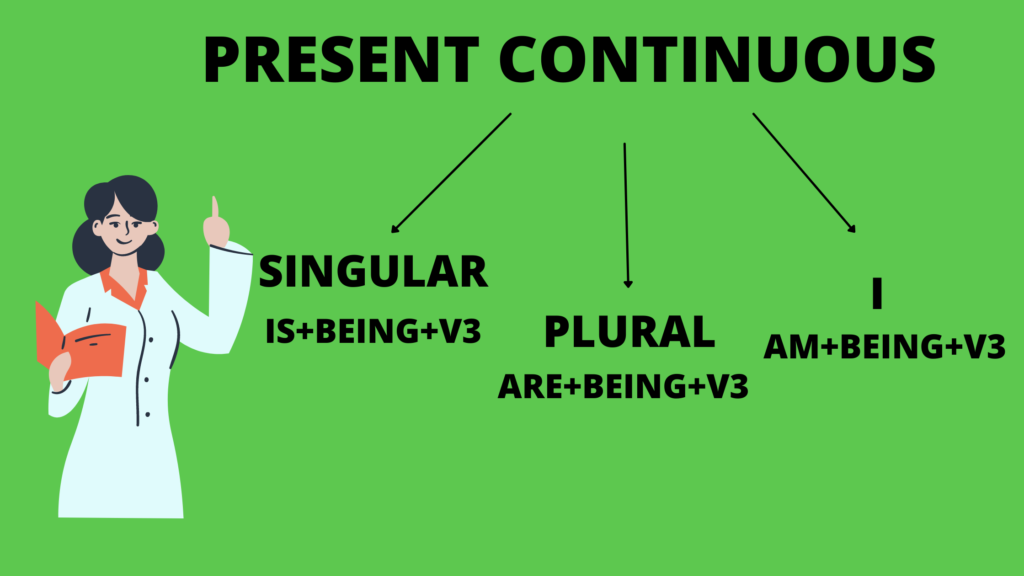
Moreover, you have to use IS with SINGULAR, ARE with PLURAL, and AM with the I. In addition, you have to use BEING after IS/AM/ARE. However, do not forget to use V3. Furthermore, If we want to say who or what performs the action while using the passive voice, we use the preposition (BY). Consequently, When we know who performed the action and are interested in him, it is always better to switch to the active voice instead.
FOR EXAMPLE:-
(SINGULAR)– 1. (positive) Fan Is moving. (ACTIVE)
- (P) Fan Is being moved. (PASSIVE)
2. (P) She Is dancing. (ACTIVE)
2. (P) She Is being danced. (PASSIVE)
3. (P) Reema uses floor cleaner to clean the floor. (ACTIVE)
3. (P) The floor cleaner is used by Reema to clean the floor. (PASSIVE)
(PLURAL) – 1. (P) They Are riding bicycles. (ACTIVE)
- (P) Bicycles are being ridden by them. (PASSIVE)
2. (P) They are requesting to you. (ACTIVE)
2. (P) You are being requested by them. (PASSIVE)
3. (P) He is inviting me to the party. (ACTIVE)
3. (P) I am being invited to the party. (PASSIVE)
Additionally, In PASSIVE the work and object are more important than the subject. Furthermore, we use an object or work at the beginning of the sentence.
ACTIVE VOICE AND PASSIVE VOICE CONTINUOUS (PRESENT NEGATIVE, INTERROGATIVE, and INTERROGATIVE NEGATIVE)
Similarly, you can make a negative by adding NOT after IS/AM/ARE. Moreover, you can make interrogative and interrogative negative sentences by keeping the helping verbs at the beginning.
FOR EXAMPLE:-
(SINGULAR) – 1. (N) Fan Is not being moved.
- (I) Is fan being moved?
- (IN) Is not fan being moved?
2. (N) I am not being invited to the party.
2. (I) Am I being invited to the party?
2. (IN) Am not I being invited to the party?
(PLURAL) – 1. (N) Bicycles are not being ridden by them.
- (I) Are bicycles being ridden by them?
- (IN) Are not bicycles being ridden by them?
PAST CONTINUOUS PASSIVE (POSITIVE, NEGATIVE, INTERROGATIVE, and INTERROGATIVE NEGATIVE)
Furthermore, THE PAST CONTINUOUS is all about THE WORK WHICH WAS GOING ON, you have to use WAS with SINGULAR and WERE with PLURAL. Similarly, do not forget to use BEING after WAS/WERE.
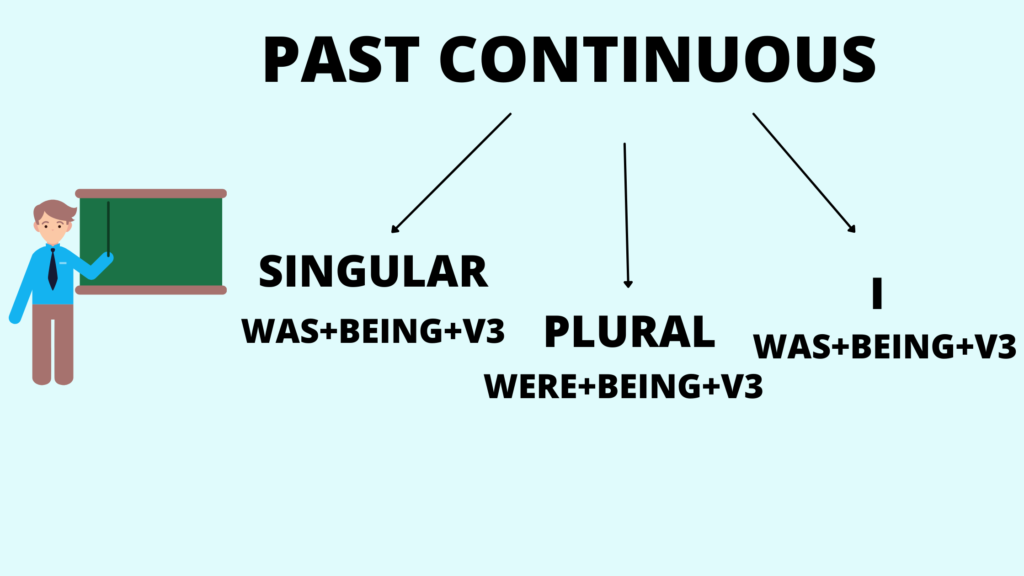
FOR EXAMPLE:-
(SINGULAR) – 1. (P) Fan was being moved.
1. (N) Fan was not being moved.
- (I) Was fan being moved?
- (IN) Was not fan being moved?
2. (P) I was being invited to the party.
2. (N) I was not being invited to the party.
2. (I) Was I being invited to the party?
2. (IN) Was not I being invited to the party?
(PLURAL) – 1. (P) Bicycles were being ridden by them.
- (N) Bicycles were not being ridden by them.
- (I) Were bicycles being ridden by them?
- (IN) Were not bicycles being ridden by them?
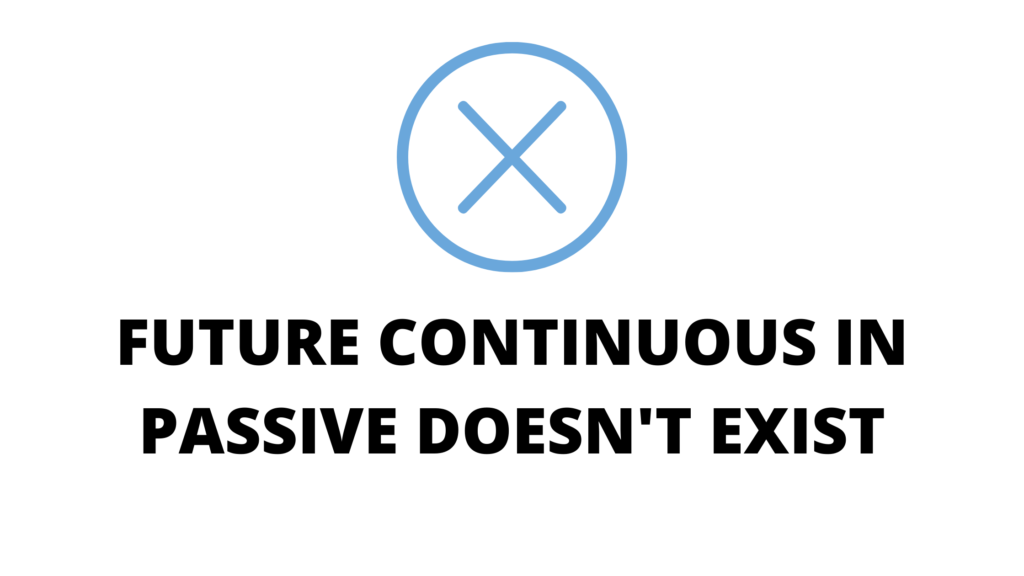
However, there is no future of PASSIVE CONTINUOUS. Additionally, Future Passive continuous does not exist and we generally do not use this in our communication. Firstly, always remember that we never use future continuous in passive. Secondly, passive always use in novels, newspapers, news, offices, and meetings, etc. In addition to this, you can simply practice speaking it for 5 to 10 minutes daily and using it in your daily conversation skills.
In conclusion, I would say only perfect practice makes a person perfect. Therefore, In the next post, we will learn about PERFECT PASSIVE. Consequently, what is the use of it? Additionally, if you have any confusion. you can simply fill the form or contact us.
[…] CLICK HERE ON THIS LINK FOR CONTINUOUS PASSIVE PART-2 […]
[…] CLICK HERE ON THIS LINK FOR MORE LEARNING […]
Hey There. I discovered your blog using msn. This is a very well written article.
I will make sure to bookmark it and return to read more of your useful information. Thank you for the post.
I’ll definitely comeback.